This is the one interval on this site that is simply due, at whatever figure your manufacturer’s maintenance schedule prints — and before any of that, the first question is whether the schedule prints one at all, because plenty of cars have no timing belt to replace. The cost of timing belt replacement is then anywhere from $367 to over $3,000 depending on which published source and which car, which is a spread that makes the national average almost useless.
Two questions, in this order. Does your car have one. What does yours cost.
Whether your car even has one
Kelley Blue Book’s page raises this and then leaves it there:
“Have a timing chain instead of a timing belt? Lucky you, because they can actually last the lifetime of your car.”
And: “not all cars use a rubber timing belt. Some use a timing chain that can actually outlast the engine.”
That is correct and it is the most consequential sentence on the page, because the entire rest of the page — the cost, the warnings, the urgency — applies to you or does not apply to you depending on which one you have. The page never says how to find out.
It is in the maintenance schedule, and it is free. If the manufacturer’s schedule for your model year lists a timing belt replacement at a mileage, you have a belt and that mileage is your answer. If there is no such line anywhere in the schedule, the engine is chain-driven and this job does not exist for you. The schedule is in the owner’s literature, and most manufacturers publish it online for the model year as well.
Ten minutes with that document settles a question that a quote cannot, and it settles it before anybody has looked at the car. It is also the only way to be certain, because a belt and a chain do the same job in the same place and neither is visible with the cover on.
The cost of timing belt replacement, in two figures that differ by more than double
Kelley Blue Book puts the job at “anywhere from $367 to $585.”
RepairPal’s estimator, figures noted as “Estimates last updated September 3, 2026,” says: “The average cost for a Timing Belt Replacement is between $918 and $1,338.”
| Source | Figure |
|---|---|
| Kelley Blue Book | $367–$585 |
| RepairPal | $918–$1,338 |
Both checked 27 September 2026. RepairPal’s midpoint is roughly 2.4 times KBB’s. On a job this size that is not a rounding difference between two estimators, it is a difference about what is being counted, and the answer is in the next section.
RepairPal’s page also carries the disclaimer that matters here: “This range does not include taxes and fees, and does not factor in your unique location. Related repairs may also be needed.”
Two-thirds of it is getting to the belt
RepairPal’s split: “Labor costs are estimated between $603 and $885 while parts are priced between $315 and $453.”
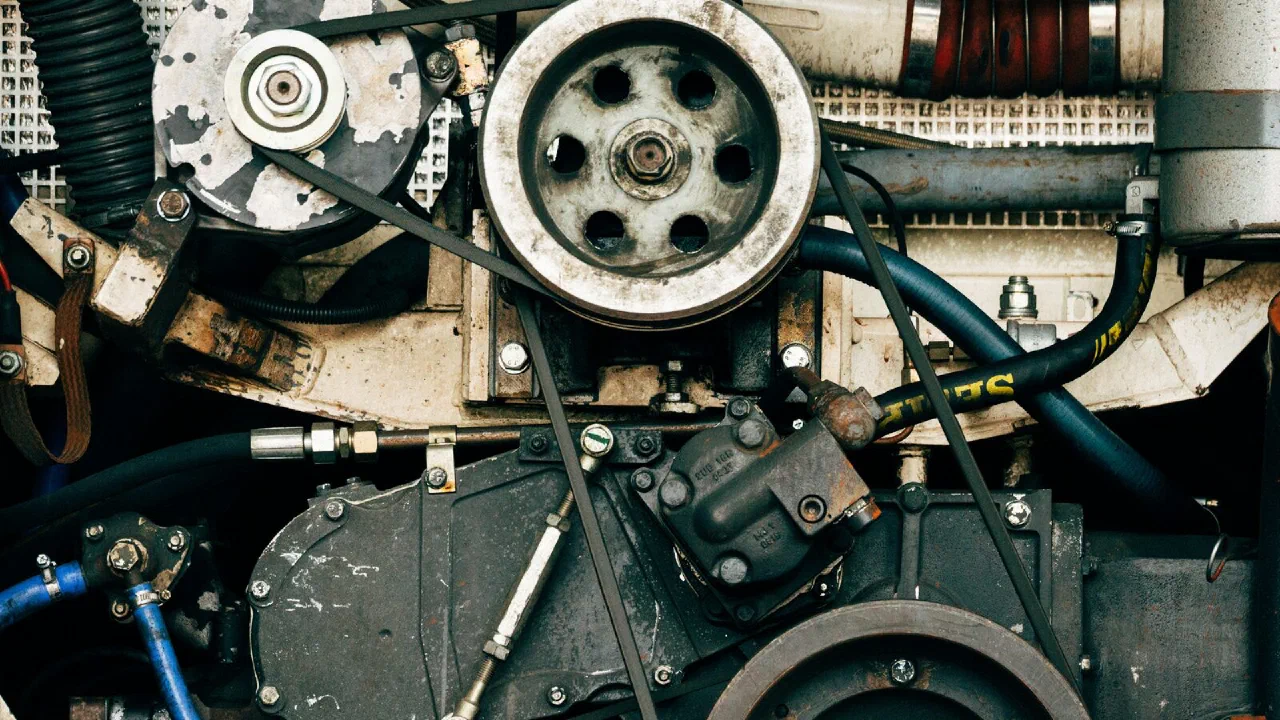
At the midpoints, $744 of labour against $384 of parts. Two-thirds of this job is access, and RepairPal describes what that access involves: the work covers removing the timing belt cover, tensioner and pulley, and “It may also be necessary for the motor mounts, engine cooling fans, radiator and other engine accessories to be removed.”
Motor mounts, cooling fans, radiator. That is why the figures disagree, and it is why the per-vehicle spread on this job is the widest on the site:
| Vehicle | RepairPal estimate |
|---|---|
| Toyota Corolla | $452–$766 |
| Ford F-150 | $2,272–$3,270 |
A factor of seven between the cheapest and the dearest of the models RepairPal lists. A national average sitting between them describes neither car. Look up the row for your model before you decide a quote is high, and if your engine is one of the transverse layouts where the radiator comes out, a four-figure quote is the job rather than the shop.
It also means the parts line is the wrong thing to argue about. On this job the belt itself is a third of the bill, and the two-thirds you cannot shop is the same two-thirds described in the arithmetic on any big repair.
The one case where the second job on the lift is in your favour
Everything on this site about the extra job added during a visit is a warning. This is the exception, and it follows directly from the sentence above.
If the radiator, the cooling fans and the accessory drive are already off to reach the belt, anything else behind them is being reached for free. The water pump is the usual candidate, because on many engines it sits in the same space. Neither KBB’s page nor RepairPal’s estimate says a water pump is included, and this site will not tell you yours is driven by the belt without your own documentation in front of it — that is a question with a per-engine answer.
But the general form of the question is sound, and it is worth asking as a question rather than waiting to be offered: “While the front of the engine is open, what else is in there, and what would each of those cost as its own visit later?” A part that is $180 today and $700 next year — because next year it needs the same teardown again — is the clearest arithmetic in vehicle maintenance, and it only appears if somebody asks.
The interval, and whose document governs
KBB gives the landscape rather than a rule: “Some automakers recommend changing a timing belt between 60,000 and 100,000” miles, while “others don’t,” and “Many of today’s timing belts can go 100,000 miles or more without needing to be replaced.”
So there is no universal figure, which is the same finding as every other interval on this site: the number is in your maintenance schedule and nowhere else. What is different here is the consequence of being past it.
Why this one is simply due
KBB does not hedge on what failure looks like. On what happens if the belt breaks:
“You’ll be stranded, and your engine will probably be damaged (metal components can actually break, hence all the noise).”
And: “How much damage is anyone’s guess. Bottom line? Don’t let this happen.”
That is the whole verdict, and it is why a site built on saying not yet says yes to this one without qualification. A belt at its published interval is a bounded cost you can look up. A belt past it is an unbounded cost you find out about at the roadside — and on a car worth a few thousand dollars, an engine is not a repair, it is the end of the car.
Which is also the reason the break-even logic does not rescue you here. A transmission decision can be deferred while you think, because a slipping transmission tells you it is slipping. A timing belt gives no notice and no symptom to monitor. Where a job has no warning stage, the interval is the warning.
What to ask before you authorise it
- “Does this engine have a belt or a chain?” Ask it even if you have already been quoted. It is answerable from the maintenance schedule and it is the only question that can make the rest of the quote irrelevant.
- “What mileage does the schedule give, and where am I against it?” A number and a number. If the recommendation is not anchored to the schedule’s figure, ask what it is anchored to.
- “What comes off to reach it, and how many hours?” This is two-thirds of the bill. It is also the honest explanation for a quote that looks double what a national average says.
- “What else is behind there, and what does each cost on its own visit?” The one time on this site where more work in the same visit is the cheaper outcome.
If the schedule lists a belt and you are at or past its mileage, authorise it. The figure to check is the row for your car, not the average — and if you are well short of the interval with no symptom, it is not due, and nothing on this page says otherwise.