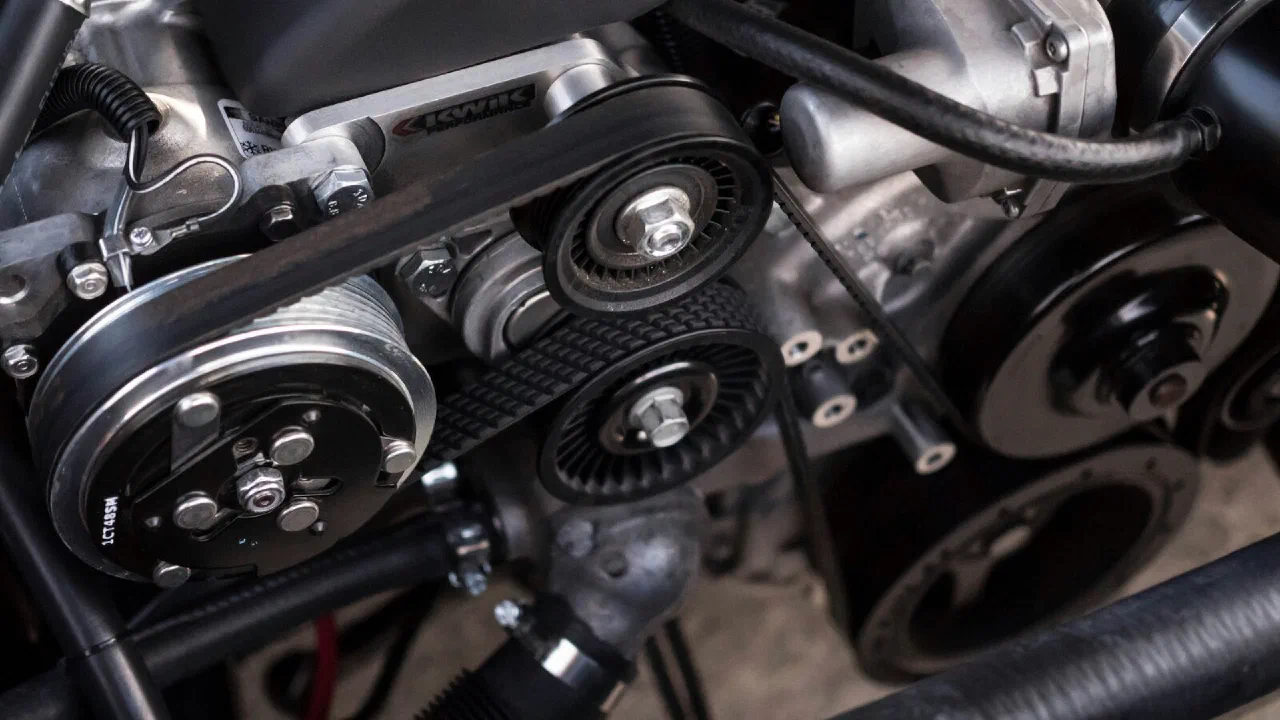
There is no mileage at which a serpentine belt becomes due, which means “you’re at 90,000, it’s time” is not an interval, it is a guess. A serpentine belt replacement cost of $154 to $212 is small enough that the money is not really the decision here. What it is replaced on is the decision, and the answer is its condition — which is a thing somebody has to actually look at.
What a serpentine belt replacement costs
RepairPal’s estimator, figures carrying the note “Estimates last updated September 3, 2026,” says: “The average cost for a Serpentine Belt Replacement is between $154 and $212.”
The split: “Labor costs are estimated between $89 and $130 while parts are priced between $65 and $82.”
At the midpoints, $109.50 of labour against $73.50 of parts — 40% of this bill is the belt itself. That is a higher parts share than any other job in this part of the queue, and it is the tell that this is a fast job on most engines. The belt is at the front, it is on the outside, and the labour line is not paying for hours of access.
Per vehicle, RepairPal’s own figures:
| Vehicle | RepairPal estimate |
|---|---|
| Toyota Corolla | $107–$151 |
| Honda CR-V | $110–$169 |
| Honda Accord | $133–$170 |
| Ford F-150 | $136–$181 |
| Nissan Altima | $138–$175 |
| Toyota Camry | $145–$204 |
| Honda Civic | $148–$194 |
| Chevrolet Silverado 1500 | $196–$303 |
Seven of the eight sit under $205 at the top of their range. Quoted $400 for a serpentine belt on a Corolla, the number to query is the hours.
There is no interval to be due at
Jiffy Lube’s own page for the service has a heading called “HOW OFTEN”. Under it, in full:
“The serpentine belt should be inspected regularly and replaced based on its condition.”
And its closing line: “Jiffy Lube® recommends following manufacturer recommendations, where applicable, for maintenance schedules and service intervals.”
That is a company that sells this replacement, on the page where it sells it, under the heading where a mileage figure would go, declining to print one. Read it as the useful admission it is rather than as evasion — there genuinely is no industry mileage for this part, and where the manufacturer publishes one it is in the maintenance schedule you already own.
Which puts a specific sentence out of bounds. “You’re due for a belt at this mileage” is not a reading off any document. It may still be a correct recommendation — the belt may be visibly finished — but then the recommendation is a finding, and a finding can be described.
The four things an inspection is looking for
Jiffy Lube names them, which makes them the checkable version of the question. It “visually inspects the serpentine belt for fraying, splitting, glazing (the working edge of the belt becomes shiny from age and wear) or any other damage.”
So: fraying, splitting, glazing, other damage. Four words, and they are your script.
Ask which one they found. A belt recommended for replacement was either frayed, split, glazed or damaged, and whoever looked at it can say which. If the answer is a mileage figure instead of one of those four, nobody has told you anything about your belt. If the answer is “it’s glazed”, that is a real finding on a $180 job and you should say yes.
This is the same pattern as the brake fluid flush — a service where the recommendation arrives without the measurement that would justify it — except that here the measurement is a look rather than a test strip, and the cost of being wrong in the shop’s favour is under two hundred dollars.
What the belt is holding up
The reason a $180 part gets its own post is what happens when it is not there. Jiffy Lube again:
“The serpentine belt is a single, continuous belt that drives multiple devices in your engine, such as the alternator, power steering pump, water pump and air conditioning compressor. If your serpentine belt breaks, all of these systems will shut down and your vehicle may overheat.”
Alternator, power steering pump, water pump, air conditioning compressor — one belt, and on the list is the water pump, which is the cooling system. That is why “you may overheat” is in a sentence about a drive belt, and it is why this is not a part to run to destruction on a long drive even though the replacement is cheap.
Note what this is not. It is not an argument that the belt is due. It is an argument that when the belt is visibly finished, the correct response to a $180 quote is to authorise it rather than to get a second opinion on a hundred and eighty dollars. The asymmetry does the work: the downside of doing it early is a small number, and the downside of doing it late is a tow. That asymmetry is the whole of the arithmetic on a big repair, running in the direction that favours spending.
When it is not due yet, and when it is
Not yet:
- A mileage figure is the only reason given. There is no published mileage. Ask what was seen.
- Nobody has looked at it. A belt cannot be recommended off a service history. It is an external part and the inspection is a visual one.
- It is on a ticket you did not come in for and nothing was described. The belt is at the front of the engine, which makes it one of the easiest things to add to a quote during a visit for something else. That is the same window priced in the post on how long an oil change takes.
Due:
- One of the four was found and named. Fraying, splitting, glazing, damage. Say yes.
- It is squealing or chirping and the noise tracks engine speed. Belt noise is not proof of a failing belt — a tensioner or an idler pulley makes noise too, and so does a belt that is merely wet. It is proof that something in that assembly wants looking at, and the look is free while the car is there.
- The manufacturer’s schedule lists one. Some do. If yours publishes a figure, that figure is the document that governs, exactly as it does for the oil change interval.
One more line worth having at the counter. If the belt is being replaced and the tensioner or an idler pulley is also quoted, those are separate parts with separate prices, and they should appear as separate lines. Ask for them itemised rather than folded into “belt service” — a single number covering three parts is a number you cannot check against anything.