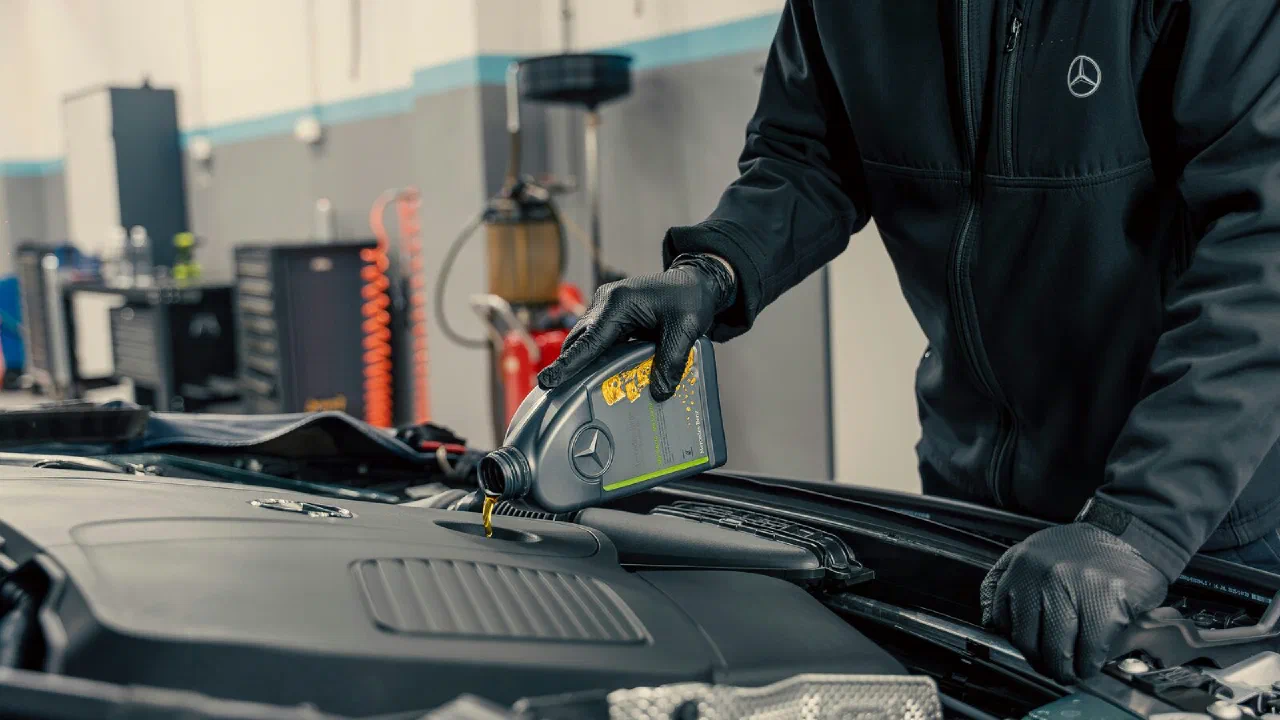
An oil change is a cheap job bought often, which means the frequency decides what it costs you over a year and the price on the sign barely matters. Get the interval out of your owner’s manual first. Then, and only then, argue about the figure.
The figure is worth knowing anyway, because the published numbers for this one job do not agree with each other. Two of the largest sites in the vertical put a price on the same service, both checked 16 September 2026, and from one end of that range to the other is more than five times.
What an oil change costs, in two published figures that do not agree
Kelley Blue Book states it plainly: “Typically, an oil and filter change using conventional oil will cost between $35 and $75,” and “If your car requires synthetic oil, you should expect to pay more (anywhere from $65 to $125).”
RepairPal’s estimator, whose figures carry the note “Estimates last updated September 3, 2026,” says: “The average cost for an Oil Change is between $160 and $188.”
| Source | Figure | What it says it covers |
|---|---|---|
| Kelley Blue Book | $35–$75 | Oil and filter change, conventional |
| Kelley Blue Book | $65–$125 | Oil and filter change, synthetic |
| RepairPal | $160–$188 | “Oil Change”, national average |
$35 to $188 is not a range, it is two different descriptions of a transaction. Neither is wrong on its own terms — but a reader holding a quote cannot use both, and nothing on either page tells them which one their quote belongs to.
RepairPal does publish per-vehicle figures under the national one, and they land well below its own average: Chevrolet Silverado 1500 at $91–$117, Honda Civic at $121–$149, Toyota Corolla at $129–$159, Toyota Camry at $130–$162, Ford F-150 at $183–$212. Eight of the most common cars on American roads, and seven of the eight sit under the “average” printed at the top of the page.
The parts line, from the same source that published the shop price
The most useful sentence on KBB’s page is not the shop price. It is this one, a few lines further down the same page: “Five quarts of conventional oil and a new filter will set you back around $30.” And for the upgrade: “For synthetic motor oil and a new filter, it’ll cost around $45 plus tax.”
That is the same publisher, on the same page, pricing the materials for the job it has just priced at the counter. Put the two next to each other, which the page never does:
On synthetic the same subtraction gives $20 to $80, against parts of about $45.
At the bottom of that range the shop is doing the work for almost nothing, which is the loss-leader the whole quick-lube format is built on — and it is why the visit, rather than the oil, is the product. That is a separate post and it is what the fifteen minutes is actually for.
Where RepairPal says the money goes
RepairPal splits its figure, and the split is the interesting half: “Labor costs are estimated between $58 and $86 while parts are priced between $101 and $103.”
Parts at $101–$103, for the materials KBB prices at about $30.
Both figures are published, both are dated, and they are describing the same two objects — some quarts of oil and a filter. The gap between them is the single largest unexplained line in this job. It is not evidence of anything by itself: RepairPal is estimating what a shop bills for parts, and KBB is quoting what the parts cost at a counter, and the difference between those two things is the shop’s margin, which is a real business rather than a scandal.
But it does tell you what you are buying. On RepairPal’s numbers, roughly three-fifths of an oil change is the parts line, and roughly two-thirds of the parts line is markup over retail. If a quote is high, it is almost never the labour. Ask what the oil and filter are being billed at, as a separate figure, before you ask about anything else.
How often you actually need one
The interval is the part that decides the annual figure, and it is also the part with a published answer that nobody at the counter is going to volunteer.
California’s own waste agency puts it as directly as a state agency can. CalRecycle’s page is titled Check Your Number, Because 3,000 Miles May Be Too Early to Change Your Oil, and it says: “The old standard of 3,000 miles is out of date and no longer applies to most cars.” It goes on: “Many cars, even older models, can be driven up to 5,000, 7,500, 10,000, and even 15,000 miles before needing an oil change.”
Then it does the thing none of the commercial pages do, and stops: “Please check your owner’s manual for the manufacturer’s recommendations for how often you should change your oil.” The page carries an explicit disclaimer that CalRecycle does not recommend a frequency for any particular make or model.
KBB’s own advice page reaches a similar place — approximately 5,000–7,500 miles on conventional, around 8,000 on a blend, 10,000 or more on synthetic — and concludes that modern vehicles on synthetic can go “7,500 to 10,000 miles — or even longer.” That page was originally published 27 May 2025 and carries an editor’s note that it has been revised since.
So: between 5,000 and 15,000 miles, depending on a document you already own. The spread between the bottom and the top of that is two to three oil changes a year on an average mileage, which at anywhere between $35 and $188 a visit is the entire argument. The price per visit is a rounding error next to how many visits you are talked into.
Which document governs, and what the sticker on your windscreen has to do with any of it, is the manual's interval against the sticker's.
When it is not due yet
Four situations where the answer is no, each of them a fact rather than a judgement:
- The sticker says due and the manual does not. The sticker was printed by whoever did the last change. It is a reminder card, not a specification. Where they disagree, the manual is the document the manufacturer will be held to.
- The oil-life monitor says you have life left. If the car computes a remaining figure, that figure is the manufacturer’s own reading of how this car has actually been driven, which is strictly more information than a mileage rule contains.
- It is due by months, not miles, and you have not driven it. Time-based intervals exist and are real. They are also the interval most often quoted at someone who drives 3,000 miles a year and is being sold four changes.
- You are there for something else and it was done recently. The car being on the lift is not an interval. That is the same pattern that shows up on the brake fluid flush, and it is the most common way a real service gets billed early.
The one that is not on this list: if the level is low or the oil is past the manual’s interval, it is due. This site says not yet where not yet is true, and this is a cheap job protecting an expensive part. Do not defer an oil change that the manual says is due to save forty dollars.
What to ask before you authorise anything else
Three questions, at the counter, in this order.
- “What is the oil and filter billed at, separately from the labour?” On RepairPal’s split that line is most of the bill. It is also the line that varies most between shops, and the one nobody quotes unless asked.
- “Which interval are you working from — the manual’s, or your own?” Some shops recommend more often than the manufacturer. That is their prerogative and it is a recommendation, not a due date.
- “Is anything on this ticket that I did not come in for?” The four services most often added during the wait are priced in the post on how long the visit takes, so that you can answer without leaving the counter.
If the answers are a parts line you can live with, the manual’s interval, and nothing extra, authorise it. If the quote is $188 on a Civic that RepairPal itself prices at $121–$149, you are not being quoted for an oil change, you are being quoted for a visit.
The rest of the fluids queue
Every fluid in this car has a published interval, a published price, and a version of the service that is sold rather than done. One fluid at a time, with the figures.