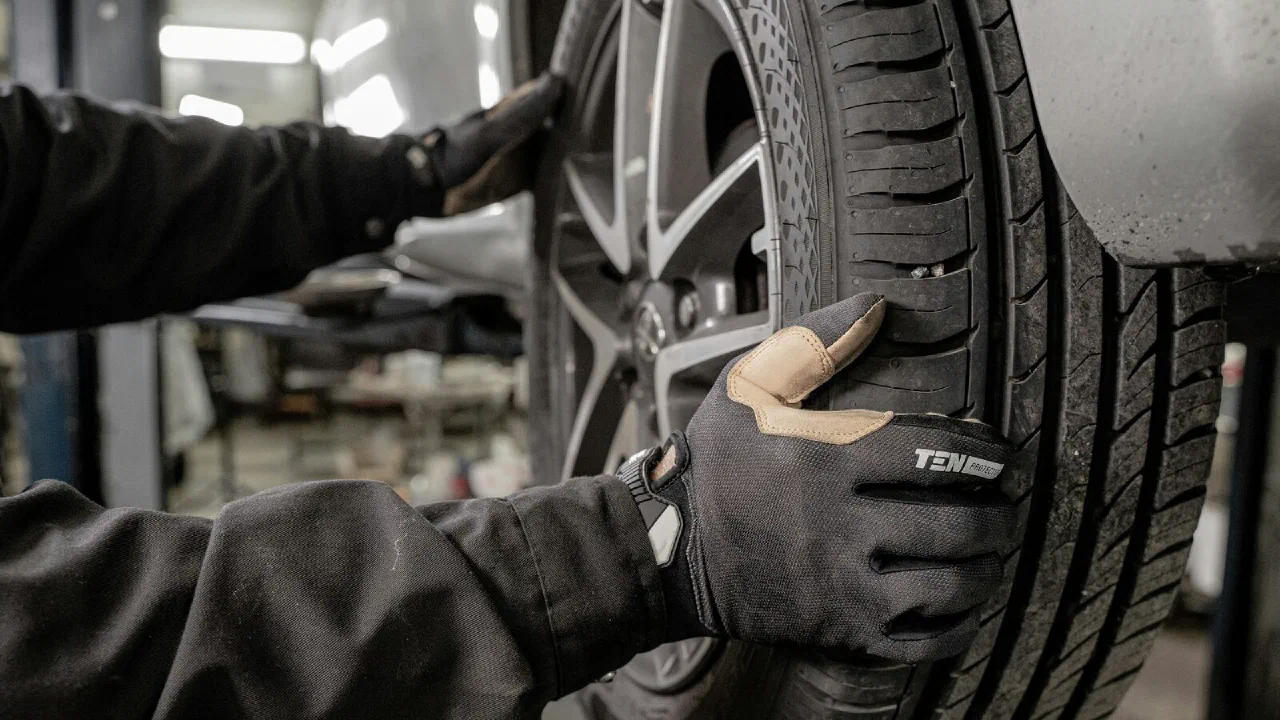
Do the front axle. Front brakes do most of the stopping on nearly every car, so front pads reach the wear limit well before the rears do — and a quote that covers all four corners when only the fronts were measured is two jobs sold as one. Ask for the measurement at each corner before you agree to the second axle.
The other half of this is what a shop adds on top of the parts, which on a front brake job is most of the bill.
What the front axle costs, materials and installed
CostHelper, checked 4 September 2026, publishes both halves of this — which almost nothing else in the vertical does:
| What | Figure |
|---|---|
| Repair shop, per axle | $130–$800 |
| Dealership, per axle | $350–$850 |
| DIY materials, one axle | $23–$285 |
| DIY materials, front and rear | $135–$439 |
| Mobile mechanic, installed | $80–$430 |
| Front and back, at a repair shop | $273–$1,025 |
Two cautions before using any of it. The page carries no publication or “last updated” date anywhere, checked on that date — so the age of these figures is unknown, and an undated price is a wrong price within a year. And the ranges are wide enough to contain almost any outcome, which is what happens when one number is asked to cover every car.
Still, the materials row is the useful one, because subtracting it is the whole exercise.
What the shop adds
Set the materials against the installed price on the same page and the difference is everything the shop contributes:
That added figure is labour, shop supplies, disposal and margin. It is not one line and it should not arrive as one. On a written estimate it typically breaks into:
- Labour — book time in hours multiplied by the shop’s rate. Jiffy Lube publishes its brake labour rate as $90–$200 an hour, checked 4 September 2026, which is the number you multiply by.
- Hardware — clips, shims and slide-pin grease. A real part, usually inexpensive, sometimes included in the pad set already.
- Shop supplies — very often a percentage of the labour total rather than a cost anyone incurred on your car.
- Disposal or environmental fee — a small fixed charge.
Only the first two are a cost of doing your job. The third is a policy, and it is a fair thing to ask about: what percentage, and of what base. Shops that charge it will tell you.
For comparison, RepairPal’s estimator puts a pad replacement at $335–$394 with parts $213–$215 and labour $122–$179 — a much narrower window than CostHelper’s, and one that at least separates the two halves.
Why the rear axle is usually a separate decision
Front brakes carry more of the work, so front pads and rotors reach their limits first. That is the ordinary wear pattern and it is why “front brakes” is the job people are quoted for.
CostHelper’s own figures make the cost of ignoring that clear: $130–$800 for one axle against $273–$1,025 for front and back. Doing both when only the front is worn does not double the price, but it adds a substantial fraction of it for parts the car has not finished using.
The measurement decides, corner by corner. 67 Pa. Code § 175.80(e)(7)(viii) rejects a vehicle when “the bonded linings are less than 2/32 inch at the thinnest point” — about 1.6mm — and that test applies to each pad, not to the car. Rear pads at 7mm are not due because the fronts are at 2/32. Your state’s inspection standard is the one that governs you.
Where doing both together genuinely pays: when the rears are close to the limit as well and you would otherwise return in a couple of months and buy the labour a second time. That is a real saving and worth taking — but it needs the rear measurement to justify it, and the shop has that measurement.
The rotor question on the front axle
Rotors are the other half of “front brakes and rotors”, and they are decided by their own number rather than by the pads. The rotor’s minimum thickness is stamped into its hat, and the reject condition in the same Pennsylvania standard is a disc “less than minimum stamped on assembly or less than manufacturer’s specifications.”
If the front rotors measure above minimum with enough material to outlive the pads going on, they do not have to be replaced today. Pads only, or pads and rotors is the full version of that decision, and what rotor replacement costs covers what the part should run.
What to ask for on a front brake quote
- The pad measurement at each corner, in millimetres or thirty-seconds. Four numbers.
- Front rotor measured thickness against the stamped minimum.
- Parts listed separately from labour, with the pad and rotor brands named.
- The shop supplies charge, as a percentage and of what.
With those four, the total either explains itself or it does not, and you will know which within a minute. What a brake job actually costs carries the same arithmetic across the whole job.